January 19, 2026
January 11, 2026
GEM-2: Decision-Aligned AI Weather Forecasting — A New Architecture for Tail Risk and Operational Use
Today we’re sharing a new paper that outlines the architecture behind GEM-2 (GemAI v2), Salient’s latest AI weather forecasting framework.
Read the paper on arXiv: https://arxiv.org/abs/2601.03753
GEM-2 is built around a simple idea: weather forecasts should be optimized for the variables people actually make decisions on — not just the variables that are easiest to simulate or evaluate. For example, it’s often more useful to model the probability that regional temperatures enter an extreme tail (the kind of outcome that drives load and price risk) than to only optimize for large-scale atmospheric state variables.
That shift has major implications for how models represent uncertainty, how well they capture rare-but-high-impact events, and whether they can be run efficiently enough to power operational workflows every day.
Why we built GEM-2
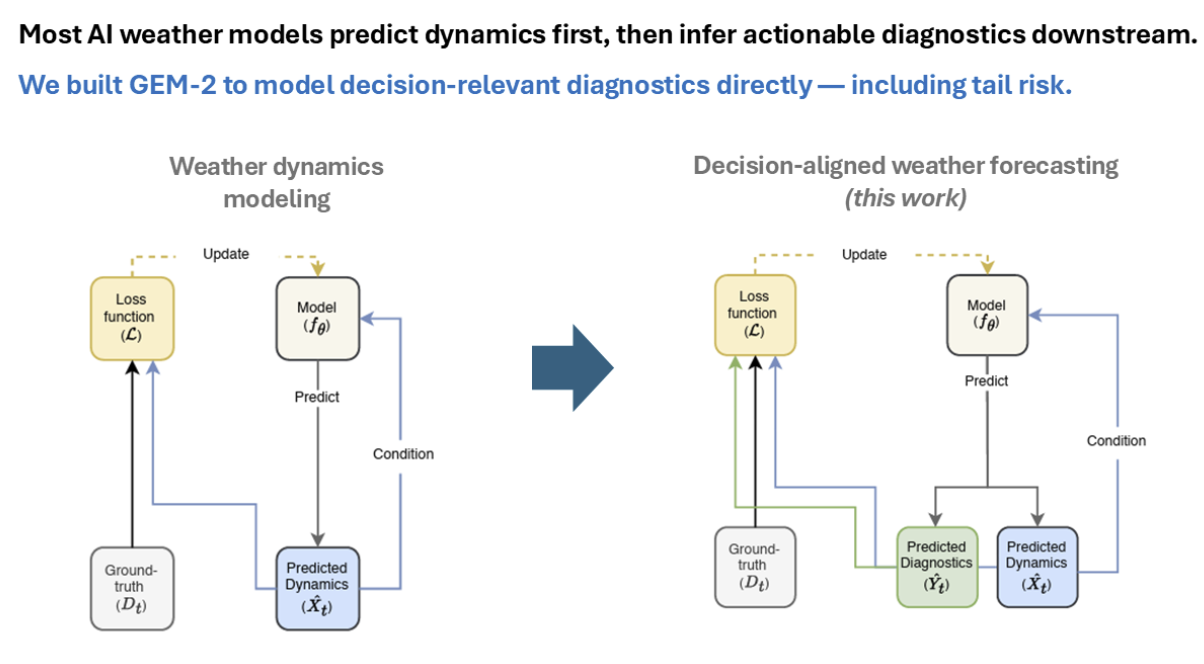
Most AI weather models today work like this:
- Predict the evolution of atmospheric dynamics (e.g., winds, pressure, temperature fields)
- Post-process those dynamics to derive “actionable” quantities like extreme heat probability, wind power risk, or precipitation thresholds
That approach makes sense if your primary goal is strong performance on classic forecast verification metrics like MAE or RMSE. But it can fall short when the end goal is decision-making under uncertainty — especially when the outcomes that matter most live in the tails of the distribution.
For many real-world workflows, the difference between “unlikely” and “very unlikely” is the difference between a normal day and a multi-million dollar decision.
A decision-aligned approach: model diagnostics directly
GEM-2 reframes the forecasting problem by treating decision-relevant diagnostic variables as first-class prediction targets.
Instead of predicting dynamics and deriving diagnostics later, GEM-2 is trained to model the probability distributions of actionable diagnostics directly — including calibrated tail behavior.
Examples of decision-relevant diagnostics include:
- Probability that regional temperatures fall in extreme percentiles (e.g., ≥ 95th)
- Probability of wind shortfall over key generation corridors
- Likelihood of precipitation totals exceeding operational thresholds
- Risk of sustained anomalies that affect load, yields, or infrastructure planning
This diagnostics-first framing also makes it easier to tune the system toward specific decision contexts. Rather than applying a one-size-fits-all post-processing layer, you can adjust diagnostic targets and objectives to reflect the needs of a particular workflow.
Why tail risk matters
Many of the quantities that drive real decisions — daily min/max temperature, peak wind gusts, short-window precipitation totals — don’t come directly from large-scale weather patterns. They depend on short-lived fluctuations and how conditions evolve between forecast steps, which makes extremes hard to infer reliably from coarse outputs.
GEM-2 is built around this gap. By modeling the probability distributions of these diagnostics directly, the system retains information about extremes that can otherwise be blurred or lost when they’re derived after the fact. The advantage for tail risk is therefore structural: extremes are part of what the model is trained to predict, not something added later.
The result is probabilistic forecasts that are:
- Better calibrated for true tail events
- Aligned with real-world decisions
Efficiency matters when forecasts become infrastructure
Weather is increasingly becoming economic infrastructure. But for many teams, operational adoption isn’t limited by interest — it’s limited by the ability to run probabilistic forecasts repeatedly, across many regions and scenarios, at a sustainable cost.
GEM-2’s architecture is designed to support:
- frequent updates
- large ensemble counts
- extensive reforecast sets
- real operational SLAs
This makes it feasible to use subseasonal forecasts not as occasional research inputs, but as production systems that support decisions day after day.
Early commercial pull
We’re seeing the strongest demand from teams that make repeated operational decisions at 2–18 week horizons, where marginal compute cost and tail-risk calibration matter.
These include workflows in:
- energy and power markets
- weather-sensitive commodities
- renewables planning
- analytics platforms
- agriculture use cases
Free product trials (for qualified teams)
Alongside the paper release, we’re opening free product trials for qualified teams interested in evaluating GemAI daily forecasts out to 126 days.
We’re prioritizing trials for teams with clear operational decision workflows — including teams that can evaluate calibration, tail risk, and downstream decision value in real settings.
Request access: https://www.salientpredictions.com/request-a-demo
January 19, 2026
January 11, 2026
GEM-2: Decision-Aligned AI Weather Forecasting — A New Architecture for Tail Risk and Operational Use
Today we’re sharing a new paper that outlines the architecture behind GEM-2 (GemAI v2), Salient’s latest AI weather forecasting framework.
Read the paper on arXiv: https://arxiv.org/abs/2601.03753
GEM-2 is built around a simple idea: weather forecasts should be optimized for the variables people actually make decisions on — not just the variables that are easiest to simulate or evaluate. For example, it’s often more useful to model the probability that regional temperatures enter an extreme tail (the kind of outcome that drives load and price risk) than to only optimize for large-scale atmospheric state variables.
That shift has major implications for how models represent uncertainty, how well they capture rare-but-high-impact events, and whether they can be run efficiently enough to power operational workflows every day.
Why we built GEM-2
Most AI weather models today work like this:
- Predict the evolution of atmospheric dynamics (e.g., winds, pressure, temperature fields)
- Post-process those dynamics to derive “actionable” quantities like extreme heat probability, wind power risk, or precipitation thresholds
That approach makes sense if your primary goal is strong performance on classic forecast verification metrics like MAE or RMSE. But it can fall short when the end goal is decision-making under uncertainty — especially when the outcomes that matter most live in the tails of the distribution.
For many real-world workflows, the difference between “unlikely” and “very unlikely” is the difference between a normal day and a multi-million dollar decision.
A decision-aligned approach: model diagnostics directly
GEM-2 reframes the forecasting problem by treating decision-relevant diagnostic variables as first-class prediction targets.
Instead of predicting dynamics and deriving diagnostics later, GEM-2 is trained to model the probability distributions of actionable diagnostics directly — including calibrated tail behavior.
Examples of decision-relevant diagnostics include:
- Probability that regional temperatures fall in extreme percentiles (e.g., ≥ 95th)
- Probability of wind shortfall over key generation corridors
- Likelihood of precipitation totals exceeding operational thresholds
- Risk of sustained anomalies that affect load, yields, or infrastructure planning
This diagnostics-first framing also makes it easier to tune the system toward specific decision contexts. Rather than applying a one-size-fits-all post-processing layer, you can adjust diagnostic targets and objectives to reflect the needs of a particular workflow.
Why tail risk matters
Many of the quantities that drive real decisions — daily min/max temperature, peak wind gusts, short-window precipitation totals — don’t come directly from large-scale weather patterns. They depend on short-lived fluctuations and how conditions evolve between forecast steps, which makes extremes hard to infer reliably from coarse outputs.
GEM-2 is built around this gap. By modeling the probability distributions of these diagnostics directly, the system retains information about extremes that can otherwise be blurred or lost when they’re derived after the fact. The advantage for tail risk is therefore structural: extremes are part of what the model is trained to predict, not something added later.
The result is probabilistic forecasts that are:
- Better calibrated for true tail events
- Aligned with real-world decisions
Efficiency matters when forecasts become infrastructure
Weather is increasingly becoming economic infrastructure. But for many teams, operational adoption isn’t limited by interest — it’s limited by the ability to run probabilistic forecasts repeatedly, across many regions and scenarios, at a sustainable cost.
GEM-2’s architecture is designed to support:
- frequent updates
- large ensemble counts
- extensive reforecast sets
- real operational SLAs
This makes it feasible to use subseasonal forecasts not as occasional research inputs, but as production systems that support decisions day after day.
Early commercial pull
We’re seeing the strongest demand from teams that make repeated operational decisions at 2–18 week horizons, where marginal compute cost and tail-risk calibration matter.
These include workflows in:
- energy and power markets
- weather-sensitive commodities
- renewables planning
- analytics platforms
- agriculture use cases
Free product trials (for qualified teams)
Alongside the paper release, we’re opening free product trials for qualified teams interested in evaluating GemAI daily forecasts out to 126 days.
We’re prioritizing trials for teams with clear operational decision workflows — including teams that can evaluate calibration, tail risk, and downstream decision value in real settings.
Request access: https://www.salientpredictions.com/request-a-demo
About Salient
Salient combines ocean and land-surface data with machine learning and climate expertise to deliver accurate and reliable subseasonal-to-seasonal weather forecasts and industry insights—two to 52 weeks in advance. Bringing together leading experts in physical oceanography, climatology and the global water cycle, machine learning, and AI, Salient helps enterprise clients improve resiliency, increase preparedness, and make better decisions in the face of a rapidly changing climate. Learn more at www.salientpredictions.com and follow on LinkedIn and X.
Contact:
No items found.